On January 31, 2020, the Swift satellite detected a powerful gamma-ray burst designated GRB 200131A. Less than a minute later, the Ondřejov robotic Small Binocular Telescope joined the observation and took images that showed a sharp drop in optical brightness. Such a rapid start to measurements is extremely rare – it is precisely in these first few minutes that a short-lived but significant phase of the explosion can occur: the so-called reverse shock wave, when part of the energy is directed back into the ejected matter.
GRB 200131A, recorded on January 31, 2020, is a textbook example. The flash was detected by the Swift satellite and the Wind satellite. During the first minute, the robotic Small Binocular Telescope (SBT) at the Ondřejov Observatory also joined the observation, taking a series of images that captured a very steep decline in optical brightness.
The team led by Martin Jelínek from the Stellar Department of ASU thus obtained unique material for analysis. The key moment was the extremely fast response – the first image was taken 57 seconds after detection on the satellite, with the processed photometry beginning 63 seconds after the flash. The series of 39 images from the main cameras and 48 from the auxiliary SBT camera was supplemented by later data from the TLS telescope in Tautenburg, other observation stations, and the Swift satellite.
More: ASU website (in Czech)
Abstract
We observed an optical afterglow of GRB200131A obtaining the first photometric point 63 s after the satellite trigger. This early observation shows a steep decay, suggesting either internal engine activity or a reverse shock. By fitting this data set, we show that the early data fit well as a reverse shock component of the GRB afterglow modeled as a thin shell expanding into a constant density interstellar matter. The fitting also shows a good agreement with a catalogued Milky Way galactic extinction and leaves little room for further extinction in the host galaxy. By judging several factors we conclude that the most likely redshift of this GRB is 0.9 ± 0.1.
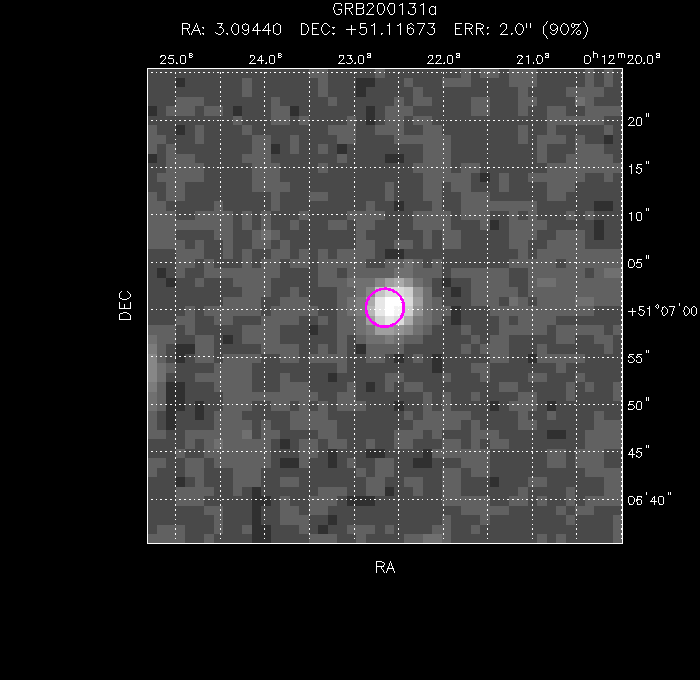
Image description: Position of the X-ray source identified by the XRT instrument on the Swift satellite against the background of an image from the UVOT telescope on the same satellite. The composition captures the surroundings of the GRB 200131A flash, with an exposure time of 540 s in the optical and near-ultraviolet range. Author: © University of Leicester
More information
- Contact: Mgr. Martin Jelínek, Ph.D.; mates@asu.cas.cz, Stellar department, ASU AV ČR
- popular article: Na čem pracujeme: Gama záblesk s přesvědčivou detekcí zpětné rázové vlny (M. Švanda, web ASU, in Czech)
- scientific paper: M. Jelínek a kol. Early steep optical decay linked to reverse shock for GRB 200131A. Acta Polytechnica, 65 (2025), 33–39.