Black holes have been among the most interesting objects in astrophysics in recent years, even though they are distant and difficult to observe. Direct imaging has so far only been successful for two objects: the black hole Sagittarius A* at the center of our Galaxy and the black hole in the galaxy M87. In both cases, we observe a disk of matter falling into the black hole in the form of a characteristic bright ring of glowing gas surrounding the dark area where the black hole itself is located.
The presence of black holes in the cores of active galaxies is predicted by their unified model, and in the case of the nearest such galaxy, M87 in the constellation Virgo, this prediction has been confirmed by observations of a powerful jet of high-energy particles. In a similar way, a black hole was identified in the center of the quasar OJ287, whose jet is even ten times stronger than that of M87. OJ287 is so bright that even amateur astronomers can observe it.
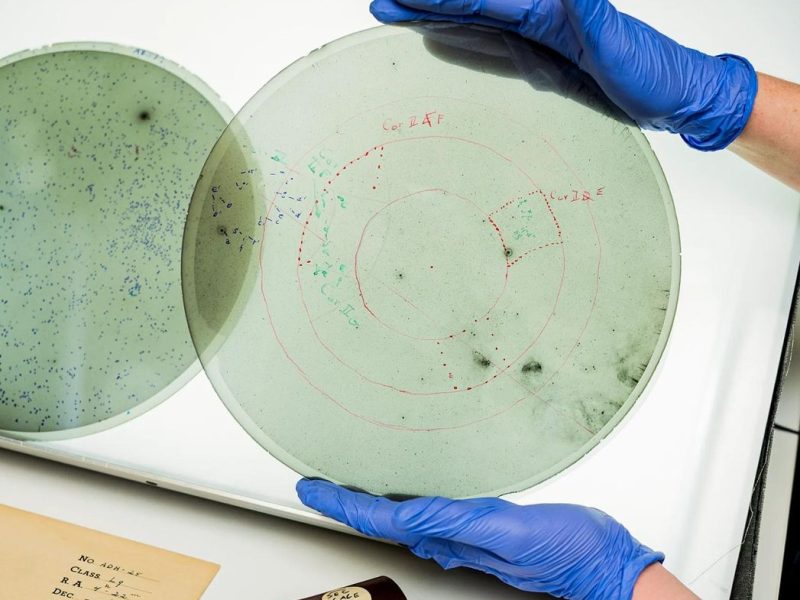
A special feature of OJ287 is the presence of a pair of black holes orbiting around a common center of gravity with a period of twelve years. This movement creates a characteristic pattern of brightness changes that can be seen in historical photographs dating back to the 19th century. Professor René Hudec and his colleagues from the Stellar Department of the Astronomical Institute of the Czech Academy of Sciences in Ondřejov have been systematically studying these archival images.
Since the discovery of this periodicity in 1982, thousands of astronomers around the world have collected data until the confirmation of the black hole binary model was proven beyond doubt. A key role in solving the problem was played by a team led by Lankeswar Dey and Professor Achamveed Gopahumar from the Tata Institute in Mumbai, in collaboration with Mauri Valtonen from the University of Turku.
More: ASU press release (in Czech, download, DOC)
Image description
The image shows a radio image of the OJ287 system from the RadioAstron observatory. Two bright spots corresponding to the two black holes (lower part of the image) and a jet from the smaller black hole (upper part) are visible. The elliptical shapes of the points are due to the limited coverage of the u-v plane by the interferometer – with perfect coverage, the image would be symmetrical and sharper. This observation represents the first direct image of a pair of black holes in a common orbit.
Contacts
Kontakty
- Source: Web ASU (in Czech)
- Martin Jelínek, ASU AV ČR, Stelar department, martin.jelinek@asu.cas.cz
- René Hudec, ASU AV ČR, Stelar department, rene.hudec@asu.cas.cz
- Pavel Suchan, ASU AV ČR, press, tel. 737 322 815, pavel.suchan@asu.cas.cz