Very massive stars represent short but extremely turbulent episodes in the evolution of galaxies. They are among the most intense sources of radiation, stellar wind, and mass ejections, enriching their surroundings with heavier elements. In their late stages, they can take on very diverse types, and it is often difficult to distinguish between them, especially if we rely solely on the visible range of electromagnetic radiation. Michaela Kraus of Stellar Department, AI ASCR led a team that examined six selected stars in the galaxies M31 and M33 in detail in the near-infrared range. The authors show that this part of the spectrum can reveal features that are hidden in the optical range and allows us to refine or radically change the existing classification of the objects under study.
…
The study by Michaela Kraus and her colleagues focuses on six objects in the galaxies M31 (in the constellation Andromeda) and M33 (in the constellation Triangulum), which have been classified ambiguously in the past. In the literature, they appeared as candidates for LBVs, as so-called Fe II stars, or even as B[e] supergiants. The authors decided to resolve these ambiguities using detailed infrared spectroscopy in the K band (wavelength 2.2–2.4 μm), which allows the detection of molecular bands of carbon monoxide CO or Pfund’s spectral series of hydrogen, which are among the key features of the different stages of massive star evolution.
more: web ASU (in Czech)
Popis obrázku
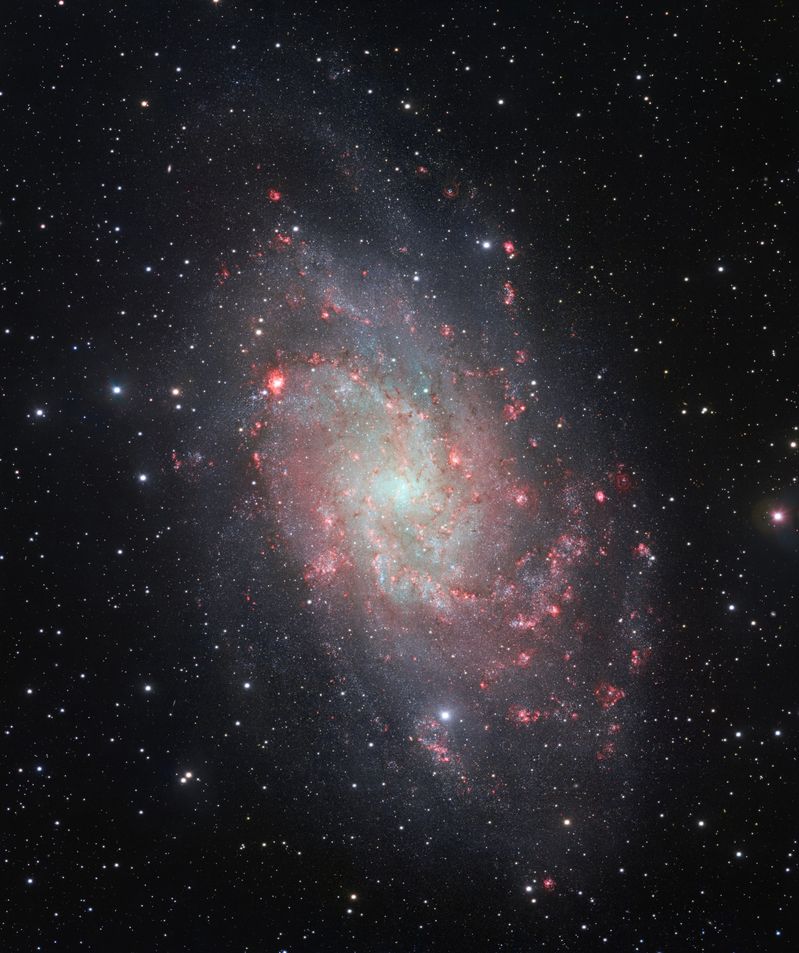
Image of the galaxy M33 in the Triangulum constellation taken by the ESO telescope. The galaxy is close enough (about 3 million light-years away) to allow observation not only of various nebulae, but even of individual stars, especially the brighter ones. It is therefore a good target for the systematic study of giant stars. (Credit, ESO)
Odkazy a další informace
- Original popular article: Výzkumy v ASU AV ČR (311): Vyvinuté obří hvězdy v galaxiích M31 a M33 infračerveným pohledem (M. Švanda, in Czech)
- science paper: M. Kraus et al, Near-infrared characterization of evolved massive stars in M31 and M33, Monthly Notices of the Royal Astronomical Society 541 (2025) 4049-4059, preprint: arXiv:2507.19249
- contact: Dr. Michaela Kraus, michaela.kraus@asu.cas.cz, Stellar Department AI ASCR