Quanta Magazine has published an interesting popular article describing the long-term work of René Hudec – emeritus researcher at the Stellar Department of the Astronomical Institute of the Czech Academy of Sciences in Ondřejov – and his colleagues on the research of the object OJ 278, which is believed to be a pair of supermassive black holes with accretion disks that will eventually merge into one.
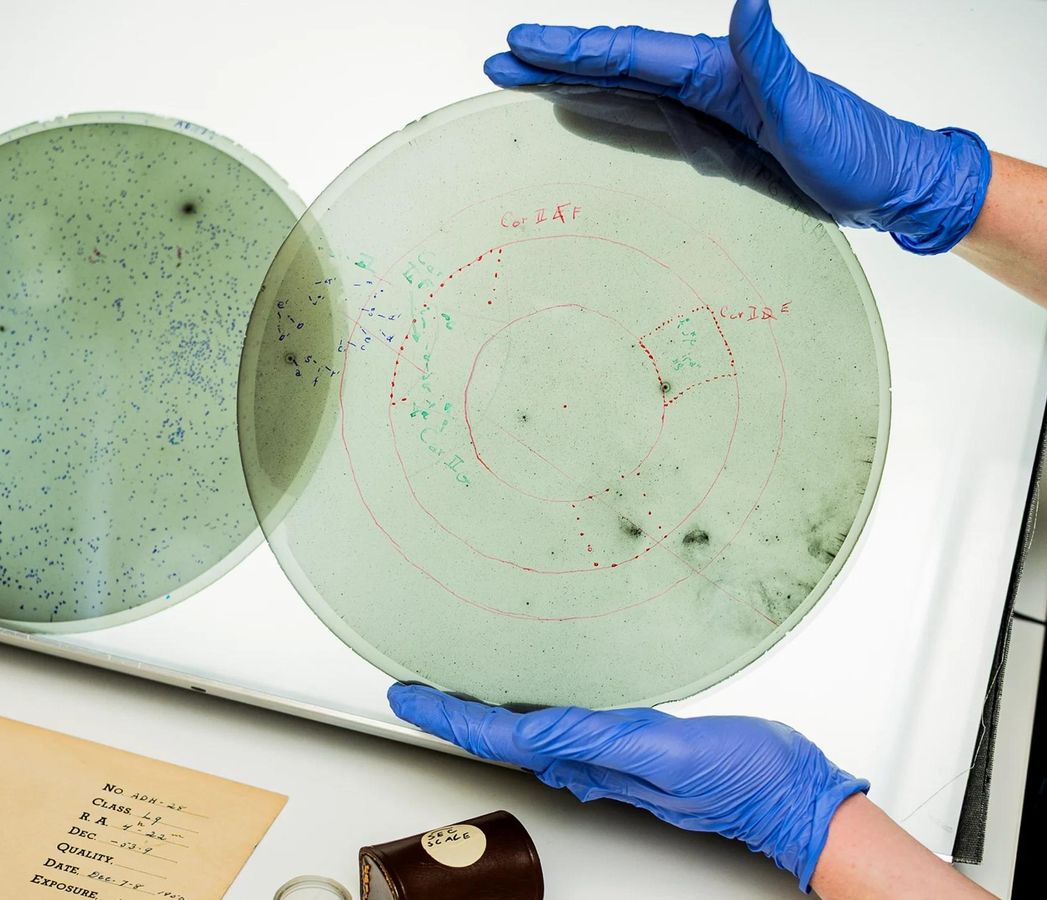
In early 2007, René Hudec was in Building D of the Harvard-Smithsonian Center for Astrophysics, thumbing through roomfuls of floor-to-ceiling cabinets that look more like a vast record collection than an academic archive. Each paper sleeve holds a glass plate, most of which are 8 by 10 inches, a historic photographic record of the cosmos from before the age of sophisticated digital detectors. Hudec, an astrophysicist at the Astronomical Institute of the Czech Academy of Sciences in Ondřejov, was searching for a specific pattern of stars that he had memorized, a region that features a binary system of mammoth yet compact objects. There, two supermassive black holes and their surrounding accretion disks are locked in a dance that will eventually merge them into one. Hudec was tracking when this system, known as OJ 287, flared in brightness.
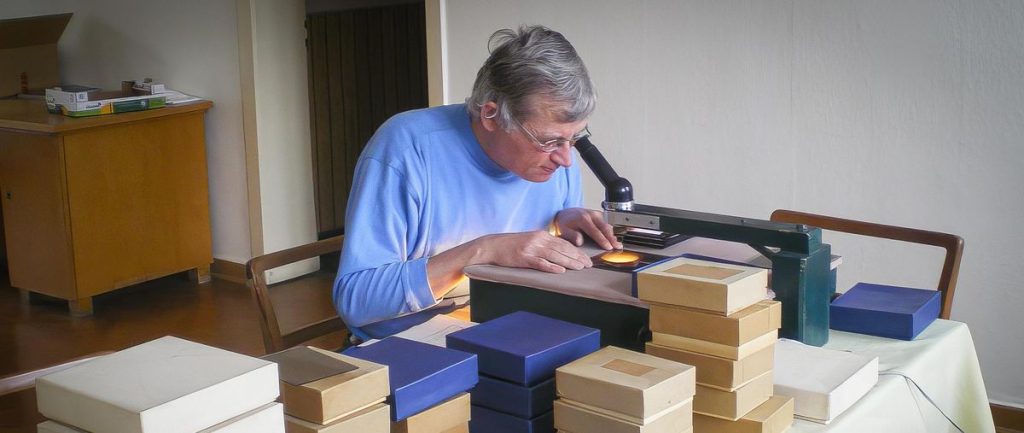
René Hudec has visited more than 70 plate collections around the world, and estimates there could be 10 million surviving glass plates. (Courtesy of Rene Hudec)
More information
- QantaMagazine.org
- original article: How Modern and Antique Technologies Reveal a Dynamic Cosmos (by Liz Kruesi)
- image in header: ‘Glass plates taken at the Armagh-Dunsink-Harvard Telescope in Bloemfontein, South Africa, in 1950 and 1951 were annotated by hand‘, from article